
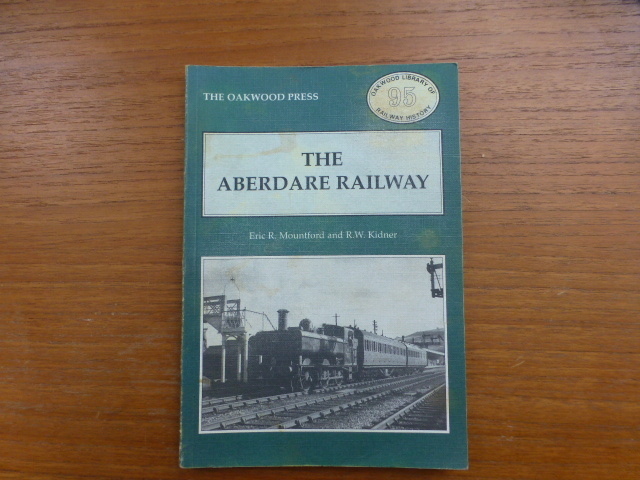
The Aberdare Railway
The Aberdare Railway
Eric Mountford and R.W. Kidner (Oakwood 1995)
Used, with bookmark, excellent condition
Cover type:
Condition:
ISBN:
Year of publication:
Page size:
Pages:
£5.00
TABLE OF CONTENTS
Chapter OneIron and Coal Found in the Valley 7
Chapter TwoPlanning The Railway 12
Chapter ThreeThe Line Opened and Working 17
Chapter FourEarly Problems Overcome 25
Chapter FivePulling out of Depression 41
Chapter SixInvasion from All Sides 49
Chapter SevenThe GWR Takes Over 69
Chapter EightTrain Services 91
Chapter NineLocomotives and Engine Sheds 103
Appendix OneSummary of Passenger Station
Opening and Closing Dates 119
Appendix TwoMineral traffic from Opening to 1871 121
Appendix Three The Dare Valley Branch 123
AUTHORS NOTE
Unlike most other valleys in east South Wales which conveniently run north to south, the Aberdare or Cynon Valley runs from south-east to north-west. For clarity, the railways through the valley have been describes as running west or east.
Another problem arose over what name to call the main valley. Valleys are normally named after the river that runs through them, such as Rhondda, Rhymney etc. The Aberdare valley is, however, so widely known by that name that it is so called in this history, although the author is only too well aware that many local inhabitants prefer it to be known, correctly, as the Cynon Valley, hence apologies are due to local readers for the choice of name.
The great export coal trade from South Wales brought the rise of Cardiff from a comparatively minor harbour to one of the world’s leading docks, due in no small measure to the efforts of the miners in the Aberdare valley, and also to the Taff Vale Railway for transporting the coal to Cardiff for shipment. Of the 31 TVR mineral trains daily to Cardiff in 1860, no less than 20 were from the Aberdare valley. By 1854 over one million tons of coal annually was being raised in the valley, and this had risen to well over two million tons by 1862. The trade recessions over the next 12 years or so kept the annual totals to around this figure. But in the 1880s they began to climb again and over three million tons were raised in 1889 and five years later a total of over four million tons had been exceeded.